Dr. Sterling Johnson addresses impact of potential cuts to NIH funding at news conference
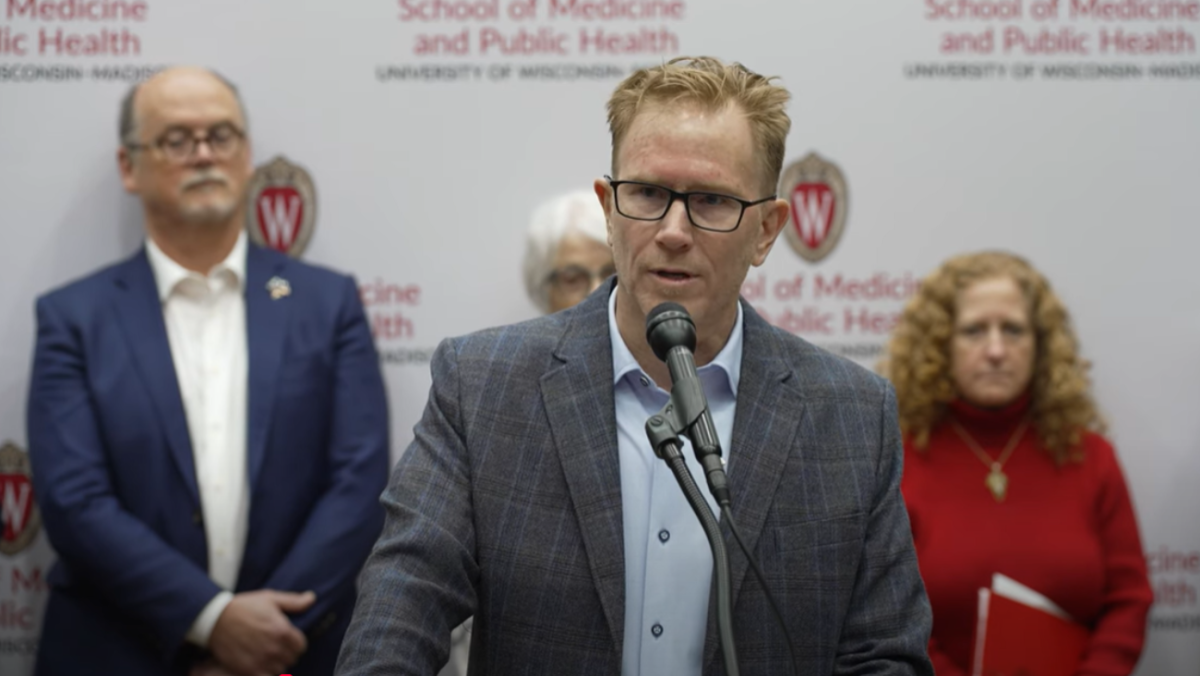
On March 6, Sterling Johnson, PhD, participated in a news conference for the media to discuss the importance of federally funded Alzheimer’s disease research at UW–Madison and its impact on people throughout Wisconsin and nationwide.
“Alzheimer’s disease affects 7 million across our country. Here in Wisconsin, there are about 120,000 people who are at the dementia phase of Alzheimer’s disease. It’s the 7th leading cause of death, and it’s certainly the only disease in the top 10 causes of death that continues to rise,” stated Johnson.
Johnson was joined by Universities of Wisconsin President Jay Rothman, Chancellor Jennifer L. Mnookin, Wisconsin Registry for Alzheimer’s Prevention (WRAP) study participant Sigrid Knuti and others. He highlighted how the WRAP study has been NIH-funded since 2006 and that the longitudinal data collected from it is being shared worldwide and contributing to significant findings. In particular, research at UW–Madison has found insight into the timeline of disease progression, which is an essential step to prevention and an eventual solution, he said.
“We know from research done here that health and lifestyle optimization won’t necessarily stop plaques and tangles from forming,” Johnson said. “But they will slow down the symptoms eventually from this disease.”
Sigrid Knuti, one of the 1,700 participants in the WRAP study, also spoke at the news conference. She described her participation in brain scans, lumbar punctures, physical endurance evaluations and other tests. Knuti joined the project in 2005 because of her family history of Alzheimer’s disease. She said she feels honored to contribute to the UW research program.
“I’m a mother and I’m also a grandmother…and I want this generation to end Alzheimer’s. And for that, I’m counting on Sterling and the University of Wisconsin to get it done,” she said. “I’m very proud of my university and very proud of what’s happening here.”